
Ductless Mini Split or Central Air? Choosing for a Lower Mainland Townhouse
No ductwork, or only certain rooms too warm? How ductless and central air actually differ, and the three questions that decide which one suits your home.
The Question Townhouse Owners Keep Asking
If you are researching Ductless Mini Split or Central Air? Choosing for a Lower Mainland Townhouse, you have probably already discovered that most cooling advice online assumes a detached house with a full duct system and a furnace in the basement. A great many Lower Mainland homes are not that.
Townhouses, duplexes, laneway homes and older houses with hydronic or baseboard heat all share the same problem: there is often no ductwork to attach cooling to, or the ductwork that exists cannot be extended. Our team at Northwind Heating, Cooling & Fireplace Showroom has this conversation constantly through the spring.
The good news is that the answer is usually clear once you know three things about your home. This guide covers what separates the two systems, and which questions actually decide it.
What the Two Systems Actually Are
Central air
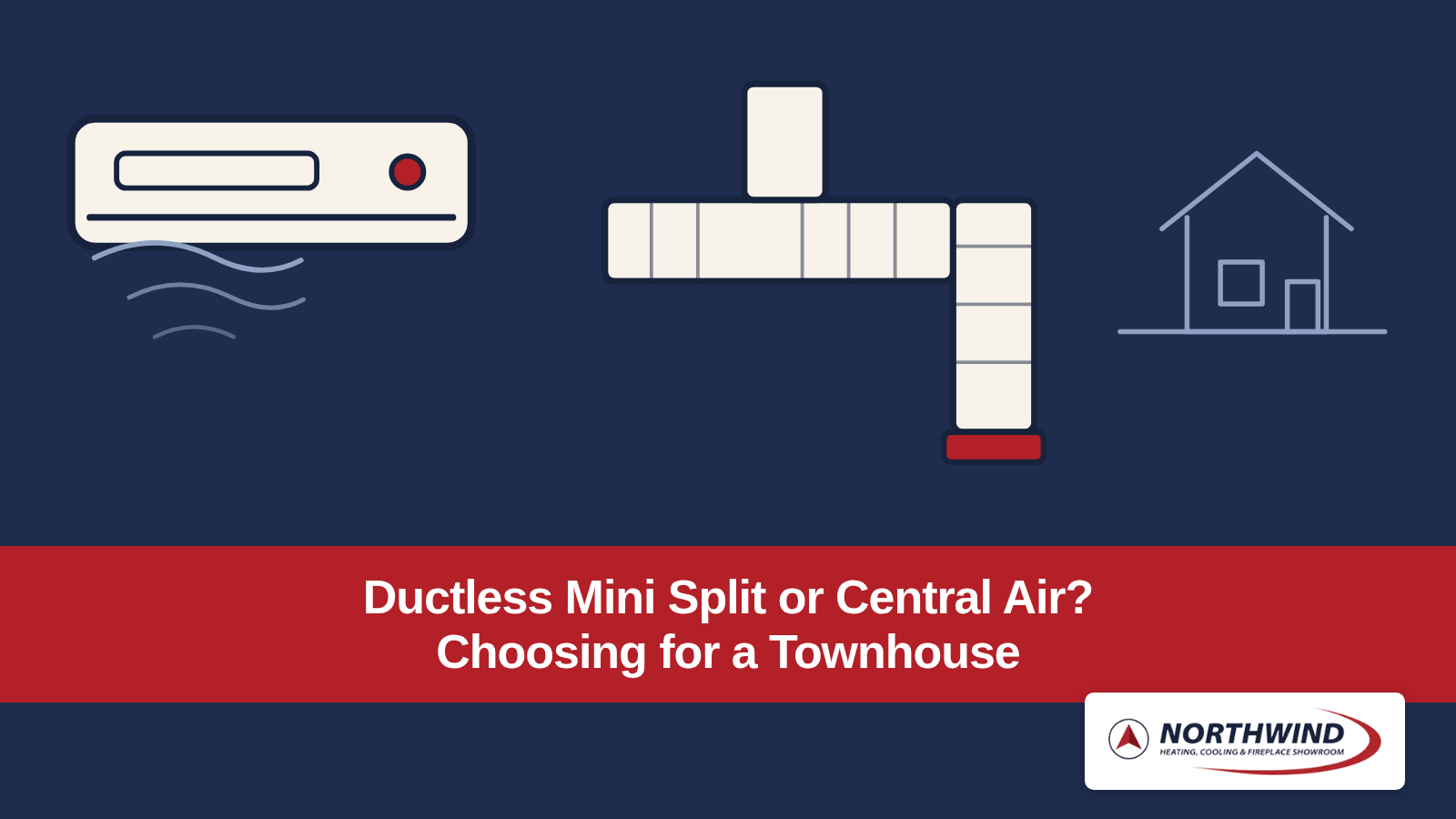
Central air conditioning adds an outdoor condenser and an indoor evaporator coil to an existing forced-air system. The furnace blower moves the cooled air through the ductwork you already have. One thermostat controls the whole house.
The critical point is the dependency: central air needs existing ductwork in reasonable condition and a blower capable of handling the cooling airflow. It is an addition to a system, not a system on its own.
Ductless mini splits
A ductless system pairs an outdoor unit with one or more indoor heads mounted on walls or ceilings. Refrigerant lines run between them through a small hole in the exterior wall. No ducts are involved at all.
Each indoor head serves its own space and, in a multi-head system, has its own temperature setting. Almost all modern ductless equipment is a heat pump, meaning it heats as well as cools. Our ductless mini split page covers the equipment side in more detail.
The Three Questions That Decide It
Rather than comparing feature lists, work through these in order. They usually settle the matter.
Do you have ductwork, and is it any good?
If your home has no ducts — baseboard heat, hydronic radiators, electric wall heaters — central air is effectively off the table. Retrofitting a full duct system into a finished townhouse means soffits, bulkheads and lost ceiling height, and the cost is rarely justified when ductless does the same job.
If you do have ducts, the next question is whether they can carry cooling air. Duct systems sized for heating alone are sometimes too small for the higher airflow cooling requires, and a system already producing cold rooms in winter will produce warm rooms in summer for the same reason. Adding cooling to an inadequate distribution system buys you an expensive version of the complaint you already have.
Are you cooling the whole home or specific rooms?
This is where townhouses differ from detached homes. In a typical three-storey townhouse the top floor is genuinely uncomfortable in July while the ground floor is fine. Cooling the entire building to fix two bedrooms is a lot of equipment aimed at a small problem.
A single ductless head serving the upper floor, or one per bedroom, addresses the actual complaint. Central air, by contrast, conditions everywhere or nowhere.
What is your heating system, and how old is it?
If you have a gas furnace with years of life left, adding central air to it is straightforward and often the cheaper route. If the furnace is near the end, the calculation changes entirely — a ductless or ducted heat pump can replace the heating and add the cooling in one job, which is a materially different decision. Our comparison of heat pumps and gas furnaces covers the running-cost side.
If you heat with electric baseboards, ductless is almost always the answer, and the heating savings are usually the larger part of the benefit rather than the cooling.
Where Each One Wins
Ductless suits
• Homes with no ductwork — baseboard, hydronic or radiant heat.
• Specific problem rooms — a top floor, a bonus room, a converted attic, a room over a garage.
• Homes where occupants disagree about temperature, since each head sets its own.
• Anyone replacing electric resistance heat, where the efficiency gain is substantial.
• Additions and conversions that the existing ductwork cannot reach.
Central air suits
• Homes with sound, adequately sized ductwork already in place.
• Whole-house cooling where every room needs it roughly equally.
• Owners who want nothing visible indoors beyond the existing registers.
• Homes with a relatively new furnace worth building on.
• Whole-house filtration needs, since a central system passes all the air through one filter — the subject of our post on choosing a MERV rating.
The Objections People Raise
"The indoor heads look industrial"
This is the most common hesitation and it is worth taking seriously, because it is a real aesthetic tradeoff. Modern heads are considerably slimmer than the equipment people remember, and ceiling cassette and low-wall floor-mounted options exist where a high wall unit would be intrusive.
It remains true that you will see the equipment. Whether that matters more than the alternative — no cooling, or a duct retrofit with dropped ceilings — is a personal judgment rather than a technical one.
"Multiple heads means multiple points of failure"
In practice the reverse is often the case. If a central system fails, the whole house loses cooling. If one head in a multi-head system fails, the others keep working.
"It will not heat properly in winter"
Cold-climate ductless equipment holds useful capacity well below the temperatures the Lower Mainland actually reaches. What surprises people is the frost, not the capacity — see our explanation of defrost cycles in coastal weather.
The Townhouse and Strata Complication
One thing applies to almost every townhouse owner and catches people out. Both systems put a condenser outside, and in a strata that means common property, which means approval.
Ductless can be the easier approval in some buildings, because the outdoor unit is smaller and the wall penetration is a single small hole. It can also be harder in others, where councils object to units visible from the street or worry about noise on a shared patio wall.
Either way, this is the step that determines your timeline rather than the installation itself. Our guide to strata approval in BC covers what councils typically ask for. Start it early — our post on planning a spring install explains why March is the month that matters.
A Third Option Worth Knowing About
The choice is not strictly binary. A ducted mini split — sometimes called a low-static or concealed-duct unit — uses a small air handler tucked into a ceiling space or closet, feeding short duct runs to two or three rooms.
It suits a townhouse floor where you want conditioned air in several bedrooms without a head in each one, and where a full central system is not feasible. It costs more than a single head and less than a duct retrofit, and it is frequently the right answer for an upper floor.
Frequently Asked Questions
Is a mini split better than central air?
Neither is better in general; they suit different homes. Ductless wins where there is no ductwork, where only certain rooms need conditioning, or where you are replacing electric baseboard heat. Central air wins where sound ductwork already exists, the whole home needs cooling equally, and the furnace has years of life left.
Can I add air conditioning to a home without ducts?
Yes, and a ductless mini split is the standard way to do it. An outdoor unit connects to one or more indoor heads through refrigerant lines passing through a small hole in the exterior wall, so no ductwork is needed. Retrofitting ducts into a finished home is usually far more disruptive and expensive than installing ductless.
How many mini split heads do I need?
It depends on your layout rather than your floor area. One head conditions the open space it serves well but does not push air effectively around corners or through closed doors, so bedrooms generally need their own. A common townhouse arrangement is one head for the main living area and one per bedroom that gets uncomfortable.
Do mini splits work in a strata townhouse?
Usually, but the outdoor unit and the wall penetration touch common property, so strata council approval is required. Some councils prefer ductless because the outdoor equipment is smaller; others have concerns about visibility or noise. Because councils typically meet monthly, start the application well before summer.
Is a ductless system noisy?
Indoor heads are generally quiet, comparable to a low fan setting, and modern units modulate rather than cycling on and off abruptly. The outdoor unit produces more noise, which is worth considering in a townhouse where it may sit near a neighbour's patio or bedroom window. Placement usually resolves it.
Can a mini split heat my home as well as cool it?
Almost all modern ductless equipment is a heat pump, so yes. In the Lower Mainland climate it will handle heating for most of the year, and cold-climate models retain useful capacity well below the temperatures we typically see. For homes on electric baseboard heat, the heating benefit is usually larger than the cooling one.
Working Out Which Suits Your Home
Most of this resolves on a site visit. Whether ductwork exists and can carry cooling air, where a condenser can reasonably sit, and what your strata will accept are all things best established by looking rather than guessing.
Northwind Heating, Cooling & Fireplace Showroom has been installing ductless systems and central air conditioning across Surrey, Langley, Delta, White Rock and the wider Lower Mainland since 1989. Get in touch and we will tell you which one your home is actually suited to.
Other Blog Posts
Customer Testimonials
Go With Experience

I cannot recommend this company enough. We were horribly jerked around by Angels Heating and Cooling. Northwind took the time to answer all our questions, we're professional, timely, affordable and sent a great technician to fix our gas fireplace.
We had a duel fuel system installed by Northwind. Our experience from installation to post installation service has been amazing.
Our fireplace had not been working. This was the only company that was willing to come out. Wes the technician was great. Diagnosed the problem and fixed it. Spoke to Deanna on the phone. She has awesome customer service skills. I would use them again and highly recommend them.
A+ Customer Service! We had a minor issue and they stopped by right away. We've used them on residential and commercial buildings and they are always on top of everything. Thank you to Chris as well!
We purchased and had Nothwind install a Valor gas fireplace for us. They did an excellent job. We did have a problem with the remote control that came with the unit but were very happy with the immediate response and repair from Northwind for warranty work.
I’ve been in the construction business for many years and the Northwind HVAC crew for sure rank up there in the number one spot. Without exception, all the work was carried out swftly, with journeyman style and with a friendly contractor/client relationship.
Home
Blogs