
The Step That Delays More Installs Than Any Other
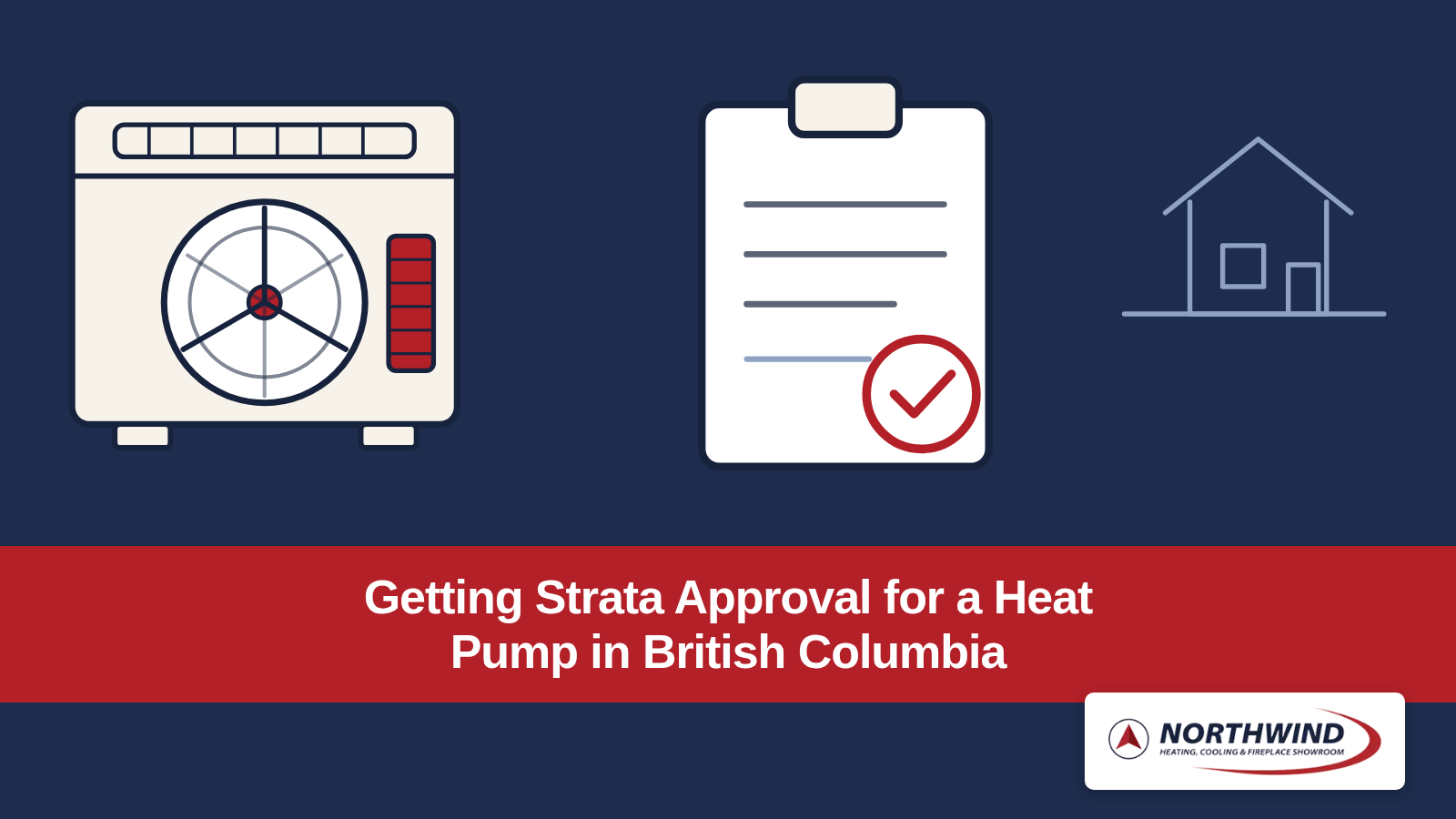
If you are researching Strata Approval for a Heat Pump in BC: What Councils Actually Ask For, you have probably already discovered that the equipment is the easy part. Our team at Northwind Heating, Cooling & Fireplace Showroom installs across a great many strata properties in Surrey, Langley, Coquitlam and Burnaby, and the single most common reason an install slips by weeks or months is not supply or scheduling. It is paperwork.
The good news is that the process is predictable. Councils across the Lower Mainland tend to ask for the same things, in the same order, and worry about the same handful of issues. If you know that in advance, you can submit a request that answers the objections before they are raised, which is the difference between approval at the next meeting and three rounds of follow-up questions.
This guide covers what you are actually asking permission for, what a council will want to see, and where applications typically stall. If you are still deciding on equipment, our heat pump and ductless mini split pages cover the options that suit strata properties.
What You Are Actually Asking For
Homeowners are often surprised that a heat pump needs approval at all, since the indoor units are inside their own home. The answer lies in what the outdoor equipment touches.
Common property versus your strata lot
In a strata, the interior of your unit is generally yours to alter within the bylaws. The exterior walls, the roof, the building envelope and the surrounding grounds are usually common property, and in many buildings a patio or balcony is limited common property, meaning it is for your exclusive use but still owned collectively.
A heat pump install almost always involves common property. The outdoor unit sits on a balcony, patio, wall bracket or ground pad. Refrigerant lines and a condensate drain pass through an exterior wall. Electrical work may run through shared spaces. Each of those is an alteration to something you do not solely own, and that is what triggers the approval requirement.
Your bylaws are the actual rulebook
Strata corporations in British Columbia operate under the Strata Property Act, but each has its own bylaws registered on title, and those bylaws are what govern your specific building. Some address exterior alterations in detail, including heat pumps by name. Others are silent and leave it to council discretion.
Request a current copy of your bylaws before doing anything else. This is the single most useful thing you can do, because it tells you whether you need council approval alone, a formal resolution at a general meeting, or simply written permission from the property manager.
What Councils Actually Ask About
Across the strata approvals we see, the concerns cluster into five areas. An application that addresses all five up front tends to move quickly.
Noise
This is the first question almost every council asks, and the one most likely to sink a poorly prepared application. Councils are thinking about the neighbouring unit whose bedroom window is near your proposed location.
Provide the manufacturer's sound rating for the specific model, in decibels, and note the proposed distance to the nearest neighbouring window or patio. Modern inverter-driven units running at partial capacity are considerably quieter than the equipment most council members are picturing, and a specification sheet does that argument better than reassurance does.
Appearance
Councils are responsible for the look of the building, and a row of mismatched outdoor units on balconies is exactly what they are trying to avoid. Expect questions about visibility from the street, colour, and whether screening is required.
Photographs of the proposed location, and a willingness to accept reasonable screening conditions, resolve most of this.
Where it physically attaches
Any penetration of the building envelope is a real concern, because a badly sealed penetration is a water ingress problem and water ingress is a strata's most expensive nightmare. Councils want to know exactly where lines pass through, how the penetration will be sealed and flashed, and who is liable if it leaks.
Wall-mounted brackets raise a related question about structural attachment. Ground-mounted or pad-mounted units avoid both issues and are often the path of least resistance where the layout allows.
Condensate drainage
An operating heat pump produces water. Councils have usually seen at least one situation where a unit dripped onto the balcony below, and they will want to know where the water goes.
Have an answer for this before you apply. It is a small detail that reads as competence when handled and as carelessness when not.
Liability and future responsibility
The council will want it established in writing that you and subsequent owners of your unit are responsible for the equipment, its maintenance, any damage arising from it, and its eventual removal or replacement. Many strata corporations use an alteration agreement or assumption of liability form for exactly this.
This is standard and reasonable. Expect it rather than resisting it.
What to Include in Your Submission
A complete package answers the questions above before they are asked. Councils meet monthly, and every unanswered question costs you a full cycle.
• The specific equipment — make, model and manufacturer specification sheet, not a general description.
• The sound rating in decibels, taken from that specification sheet.
• Photographs of the proposed outdoor location, and of where lines will penetrate the wall.
• A simple diagram or marked-up photo showing unit placement, line routing and the condensate route.
• Your contractor's licence and insurance details.
• Confirmation of who performs the work, including electrical and gas trades where relevant.
• A signed alteration or liability agreement if your bylaws require one.
Councils are volunteers. A submission they can approve without doing research is one they approve faster.
Where Applications Usually Stall
• Applying with no specific model chosen. A council cannot assess noise or appearance from a generic request.
• Missing the meeting date. Councils typically meet monthly. Submitting the day after a meeting can cost four weeks before anyone even reads it.
• No answer on condensate. A predictable question that reliably triggers a follow-up round.
• Assuming a precedent applies. Another owner having a unit installed does not mean it was approved, or approved on terms that transfer to your location.
• Starting work before written approval. Verbal agreement from a council member is not approval, and a strata can require removal at the owner's cost.
How This Affects Your Timeline
Build the approval into your planning rather than treating it as an afterthought. Realistically, allow for gathering bylaws and specifications, submitting ahead of a monthly council meeting, and a possible round of follow-up questions.
The practical implication is seasonal. If you want cooling for summer, beginning the strata conversation in late winter or early spring gives you room. Starting in June, during the first heat wave, usually means the approval and the installation queue collide at the worst possible moment.
The same logic applies to heating. Our post on why systems fail on the first cold night covers the equivalent problem at the other end of the year.
If Your Strata Says No
A refusal is not always final, and it is worth understanding the reason before accepting it.
If the objection is noise, a quieter model or a different location may resolve it. If it is appearance, screening may. If the concern is envelope penetration, a different mounting approach may sidestep it entirely. Councils are usually objecting to a specific risk rather than to the concept.
Where the building genuinely cannot accommodate outdoor equipment, there are still options worth exploring for comfort and air quality, and it is worth a conversation rather than assuming nothing can be done.
Frequently Asked Questions
Do I need strata approval to install a heat pump in BC?
Almost always, yes. Even though the indoor equipment is inside your own unit, the outdoor unit, the refrigerant lines passing through an exterior wall and the condensate drain all involve common property or limited common property. Your strata's registered bylaws set out the exact process, so request a current copy before you begin.
What does a strata council want to know about a heat pump?
Five things, consistently: how loud the unit is, how visible it will be, where and how it attaches to the building, where condensate water drains, and who is liable for the equipment and any damage in future. A submission that answers all five with a specific model, a specification sheet and photographs moves considerably faster than a general request.
How long does strata approval take?
It depends on your council's meeting schedule, which is typically monthly, and whether your submission is complete. A thorough package can be approved in a single cycle. An incomplete one that generates follow-up questions can take several. Submitting well ahead of a scheduled meeting rather than just after one makes a real difference.
Can my strata refuse a heat pump?
A strata can refuse alterations to common property, and the grounds are usually specific — noise, appearance, envelope penetration or liability. Because the objection is normally to a particular risk rather than to heat pumps in principle, a revised proposal with a quieter model, a different location or added screening will often succeed where the first attempt did not.
Can I install a heat pump on a balcony?
In many buildings yes, subject to approval, though balconies are usually limited common property rather than yours outright. Councils will focus on noise reaching neighbouring units, weight and attachment, and where condensate drains so it does not fall onto the balcony below. Some bylaws prohibit balcony equipment specifically, which is why reading them first matters.
What if my building won't allow outdoor equipment at all?
It is worth confirming that this is a bylaw prohibition rather than a council preference, and worth asking whether a different mounting location changes the answer. Where outdoor equipment genuinely is not possible, there are still routes to improving comfort and air quality indoors, and those are worth discussing with an installer who has worked in similar buildings.
Getting It Through the First Time
Most strata refusals we see are responses to incomplete applications rather than to heat pumps. A specific model, a sound rating, clear photographs and a proper answer on drainage will get you through the majority of councils on the first attempt.
Northwind Heating, Cooling & Fireplace Showroom has been installing in Lower Mainland strata properties since 1989, and we can supply the specification sheets, drawings and insurance documentation your council will ask for as part of the quote. Get in touch and we will put together a package your council can actually approve.
Other Blog Posts
Customer Testimonials
Go With Experience

I cannot recommend this company enough. We were horribly jerked around by Angels Heating and Cooling. Northwind took the time to answer all our questions, we're professional, timely, affordable and sent a great technician to fix our gas fireplace.
We had a duel fuel system installed by Northwind. Our experience from installation to post installation service has been amazing.
Our fireplace had not been working. This was the only company that was willing to come out. Wes the technician was great. Diagnosed the problem and fixed it. Spoke to Deanna on the phone. She has awesome customer service skills. I would use them again and highly recommend them.
A+ Customer Service! We had a minor issue and they stopped by right away. We've used them on residential and commercial buildings and they are always on top of everything. Thank you to Chris as well!
We purchased and had Nothwind install a Valor gas fireplace for us. They did an excellent job. We did have a problem with the remote control that came with the unit but were very happy with the immediate response and repair from Northwind for warranty work.
I’ve been in the construction business for many years and the Northwind HVAC crew for sure rank up there in the number one spot. Without exception, all the work was carried out swftly, with journeyman style and with a friendly contractor/client relationship.
Home
Blogs