
The House Is Warm, Something Outside Is Running, and Nothing Is Happening
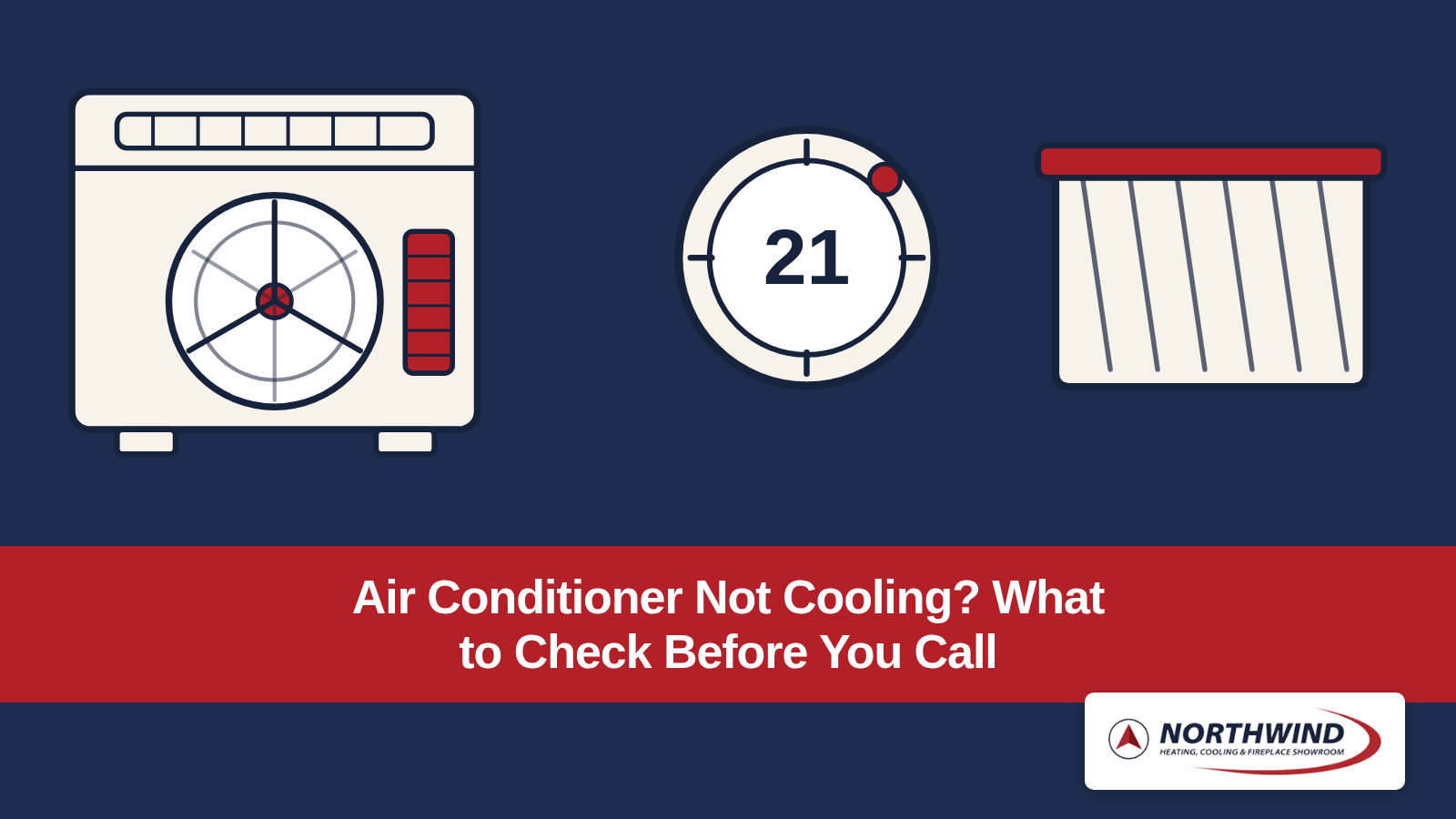
If you are researching Air Conditioner Not Cooling? What to Check Before You Call, you are probably standing in a warm hallway in July, listening to the unit outside hum away while the air at the registers feels like room temperature. It is an uncomfortable place to be, and the easiest moment to book a call you did not need.
Many no-cooling calls we take in Surrey, Langley, Delta and White Rock turn out to be a thermostat in the wrong mode, a breaker that tripped overnight, a filter unchanged since March, or a coil frozen into ice. The rest are genuine faults needing gauges and a licence.
What follows is the order our team at Northwind Heating, Cooling & Fireplace Showroom works through on the phone on a hot afternoon. Take it in sequence rather than jumping to the most dramatic explanation. Further down is a list of what not to touch, and an honest word about wait times in a heat event.
Start at the Thermostat, Even If You Are Certain It Is Fine
Mode, setpoint, schedule and batteries
More systems are found in heat or off than anyone admits, particularly after a power cut. Confirm the mode is cool, then drop the setpoint several degrees below room temperature — a thermostat set to 24 in a house at 23 has no reason to call for cooling. If the screen is dim or unresponsive, fit fresh batteries.
Knowing what normal actually looks like
Air conditioners are sized for typical conditions rather than extremes, so long run times in a heat event are expected, not a fault — we have written separately on what normal air conditioner runtime looks like on a hot day. A system running long while slowly gaining ground is working. One running constantly while the house warms is not.
Check the Power to Both Halves of the System
There are usually two breakers, not one
A split system has an indoor half and an outdoor half, usually on separate circuits. The indoor unit shares the furnace circuit; the outdoor condenser has its own larger breaker. If it has tripped, the indoor fan carries on pushing unconditioned air around the house. A trip is not always visible, so push each breaker firmly off and back on.
The outdoor disconnect, and resetting only once
Most outdoor units have a small disconnect box on the wall beside them, often switched off for painting or siding work and forgotten. Confirm it is on, and otherwise leave it alone. Reset a breaker once only: if it trips again, something is drawing current it should not be, and repeated resetting risks fire and turns a repair into a replacement.
The Filter Is the Single Most Common Cause We Find
What a restricted filter does to cooling
Cooling depends on a steady volume of warm indoor air crossing a cold coil. Choke that airflow and the coil runs colder than it should, output weakens, and the house stops keeping up. Filter choice matters as much as age, which is why we go through choosing a filter MERV rating that suits your equipment rather than buying the densest one on the shelf.
How to tell without guessing
Hold the filter up to a window. If you cannot see light through it, it is finished, whatever date is on the frame. With cottonwood, construction dust and pets, a one-inch filter usually needs changing every two to three months. Fit the new one with the arrow pointing towards the furnace, and never run without a filter.
A Frozen Evaporator Coil, and the One Right Response
How to recognise it
The signs are consistent: very little air at the registers, what there is feeling cool but thin, frost on the copper line where it leaves the indoor unit, and often water pooling near the furnace as the ice melts.
Switch to fan only and let it thaw
Turn cooling off and set the thermostat fan to on. Room-temperature air thaws the coil far faster than switching everything off, while running cooling moves almost no air and works the compressor against a blockage. Do not chip at the ice or apply heat. Expect one to several hours.
Why it froze in the first place
Once thawed, change the filter, open every register and try again. If it freezes a second time, the cause is either an airflow restriction you have not found — a crushed duct, a blocked return, a dirty blower wheel — or low refrigerant charge, which means a leak.
Work Your Way Outside and Around the House
Give the outdoor unit room to breathe
The condenser rejects your home's heat into the air and needs space to do it. Cedar hedging grown in tight, a new fence panel, stacked furniture or cottonwood fluff in the fins all cut capacity. Aim for roughly a metre of clearance. Rinse the fins gently with a hose, unit switched off — never a pressure washer, never with the grille removed.
The condensate float switch
Cooling produces condensate, and it has to drain away. If the line clogs — algae is the usual culprit in our damp summers — a small float switch shuts cooling down deliberately so water does not overflow into the furnace or a ceiling. The symptom is a system that will not cool while the fan and heating work normally.
Registers, returns and one warm room
Check that supply registers are open and not blocked by furniture, and that return grilles are clear. If the house cools reasonably except for one or two rooms, that is distribution rather than equipment — we cover it in our piece on rooms that never match the rest of the house.
What to Leave Alone, and Why
• Refrigerant. Handling it requires certification, and the system is sealed and under pressure.
• Capacitors. They hold a dangerous charge long after the power is off, and they look harmless.
• Contactors, boards and wiring. A meter reading means nothing without knowing what it should be.
• Anything behind a screwed-on panel. If a tool is needed to open it, it is not homeowner territory.
What topping up refrigerant really means
An air conditioner does not consume refrigerant the way a car consumes fuel. It is sealed, and the same charge circulates for the life of the equipment. If a system is low, it is low for exactly one reason: it is leaking.
Adding refrigerant without repairing the leak is not a repair. It hides the fault, vents refrigerant to the atmosphere over the following months, and leaves you paying again next summer. A reasonable technician will look for the leak, tell you where it is, and say honestly whether repairing it makes sense on equipment of that age.
Honest Expectations When the Whole Region Is Hot
During a heat event, every cooling company in the Lower Mainland takes several days of calls in a morning. Same-day attendance is often not possible, and anyone promising it to everybody is not being straight with you. Calls are triaged, with vulnerable occupants and total failures ahead of systems that are cooling but underperforming.
Two things help. Call early rather than waiting to see if it improves, because the queue only lengthens through the week. And do the checks above first, so what you tell us is specific — which breakers you checked, whether the coil was iced, when the filter was last changed.
Frequently Asked Questions
Why is my AC not cooling?
The most common causes are a thermostat in the wrong mode or setpoint, a tripped breaker on the outdoor unit, a clogged air filter, or a frozen evaporator coil — all of which a homeowner can check safely. Work through them in that order first. If all four check out, the fault is likely the charge, compressor or electrical controls, which need a technician.
Why is my AC running but blowing warm air?
Air moving but not cold usually means the indoor fan is working while the outdoor condenser is not, most often because its breaker or disconnect switch is off. Check that breaker and the disconnect box beside the unit. If both are on and the outdoor fan still is not turning, stop resetting it and book service.
Should I turn off my air conditioner if the coil is frozen?
Yes — switch cooling off immediately and set the thermostat fan to on so room-temperature air thaws the ice. Running cooling on a frozen coil moves almost no air and strains the compressor. Never chip at the ice or apply heat. Once thawed, change the filter and open all registers before trying again.
How long does it take a frozen AC coil to thaw?
With the fan running and cooling off, a frozen coil typically takes one to several hours to clear, depending on the build-up. Leaving the system off entirely takes longer. Put towels beneath the furnace for meltwater. If it freezes again, the cause is restricted airflow or low refrigerant.
Does an air conditioner need refrigerant topped up every year?
No — an air conditioner is a sealed system that does not consume refrigerant, so it should never need routine topping up. If the charge is low, there is a leak. Adding refrigerant without repairing that leak treats the symptom and vents refrigerant to the atmosphere. Ask any contractor proposing a top-up to find it.
How long should I wait for AC repair during a heat wave?
During a regional heat event, expect longer waits than usual, because demand across the Lower Mainland exceeds what any company can attend in a day. Calls are generally prioritised by severity and by the vulnerability of the occupants. Calling early shortens your wait, and the checks above sometimes resolve the problem without a visit.
Before You Pick up the Phone
Run the sequence: thermostat mode and setpoint, batteries, both breakers and the disconnect, the filter, the coil, clearance around the outdoor unit, the condensate drain, and every register. It takes about fifteen minutes, and either fixes the problem or tells you a lot about what is wrong.
If you reach the end of that list and the house is still warm, what remains sits on the far side of a panel — charge, compressor, controls — where a homeowner stops and a technician starts.
Northwind Heating, Cooling & Fireplace Showroom has been installing and servicing heating, cooling, heat pumps, ductless systems, fireplaces, water heaters, outdoor heating and indoor air quality equipment across Surrey, Langley, Delta, White Rock and the wider Lower Mainland since 1989, and is a registered CleanBC contractor. If the checks above have not sorted it, our air conditioning repair and service team can take it from there. Get in touch and tell us what you found — it genuinely speeds things up.
Other Blog Posts
Customer Testimonials
Go With Experience

I cannot recommend this company enough. We were horribly jerked around by Angels Heating and Cooling. Northwind took the time to answer all our questions, we're professional, timely, affordable and sent a great technician to fix our gas fireplace.
We had a duel fuel system installed by Northwind. Our experience from installation to post installation service has been amazing.
Our fireplace had not been working. This was the only company that was willing to come out. Wes the technician was great. Diagnosed the problem and fixed it. Spoke to Deanna on the phone. She has awesome customer service skills. I would use them again and highly recommend them.
A+ Customer Service! We had a minor issue and they stopped by right away. We've used them on residential and commercial buildings and they are always on top of everything. Thank you to Chris as well!
We purchased and had Nothwind install a Valor gas fireplace for us. They did an excellent job. We did have a problem with the remote control that came with the unit but were very happy with the immediate response and repair from Northwind for warranty work.
I’ve been in the construction business for many years and the Northwind HVAC crew for sure rank up there in the number one spot. Without exception, all the work was carried out swftly, with journeyman style and with a friendly contractor/client relationship.
Home
Blogs