
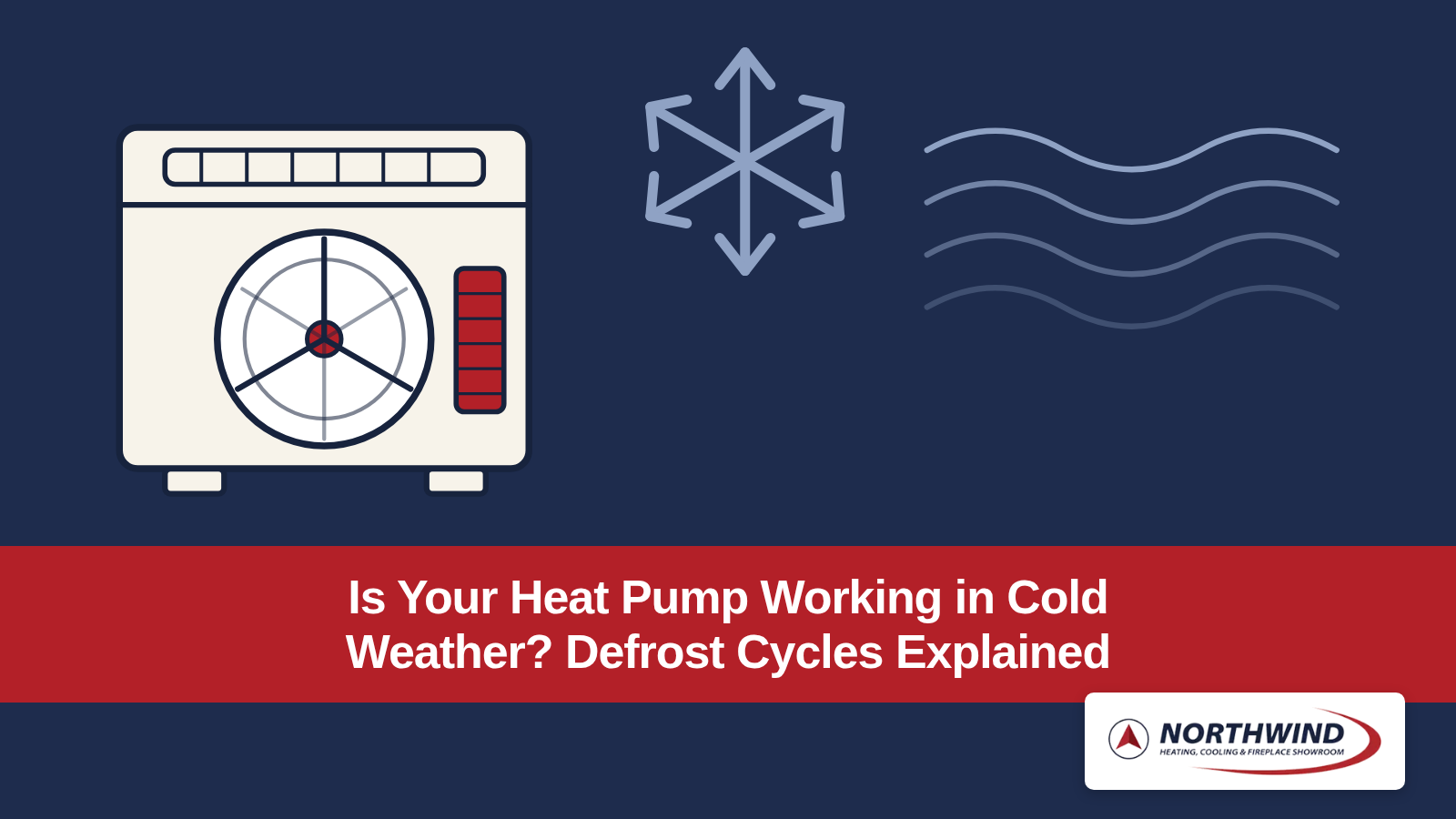
Is Your Heat Pump Actually Working in Cold Weather? Defrost Cycles Explained
Frost on your heat pump in winter is normal. What a defrost cycle looks like, how long it should last, and the signs that mean something is actually wrong.
The Steam That Worries People
If you are researching Is Your Heat Pump Actually Working in Cold Weather? Defrost Cycles Explained, there is a good chance you looked out on a damp February morning, saw your outdoor unit covered in frost or producing what looked like steam, and wondered whether something had gone badly wrong.
Almost every time, nothing has. What you are watching is a defrost cycle, which is a normal and designed part of how a heat pump operates in cool, damp weather. Our team at Northwind Heating, Cooling & Fireplace Showroom fields this call every winter, and the great majority end with a homeowner who is reassured rather than one who needs a repair.
That said, there is a version of this that genuinely is a fault, and the difference is easy to learn. This guide covers what a normal defrost looks like, how long it should take, and the specific signs that mean you should call someone.
Why a Heat Pump Frosts Up at All
Understanding the mechanism makes the rest obvious.
The outdoor coil is colder than the outdoor air
In heating mode a heat pump extracts heat from outside air. To do that, the refrigerant in the outdoor coil has to be colder than the air around it, because heat only moves from warmer to cooler. On a 4°C morning, that coil may be several degrees below freezing.
Moisture in the passing air condenses on that cold surface and freezes. Frost builds gradually, and as it does it insulates the coil and blocks airflow through it, which steadily reduces the unit's ability to absorb heat.
Defrost is the designed response
To clear it, the unit temporarily reverses its refrigerant flow, effectively running in cooling mode for a few minutes. That sends hot refrigerant through the outdoor coil and melts the frost off it.
During those minutes the outdoor fan usually stops, you may hear a distinct clunk as the reversing valve operates, and steam rises from the unit as melted frost evaporates off a warm coil. Indoors, most systems briefly engage auxiliary heat so the air from your registers does not turn cold.
Our climate produces more defrost cycles, not fewer
Here is the part that surprises people. Frost formation needs two things: a coil below freezing and moisture in the air. The Lower Mainland supplies both in abundance for months at a time.
A drier, colder region actually produces less frosting in deep winter, because very cold air holds very little moisture. Our damp 2–6°C conditions are close to ideal for frost formation, which means heat pumps here defrost more often than in many colder places. More frequent defrost cycles in Surrey are not a sign of a struggling unit; they are a sign of a coastal winter.
What Normal Looks Like
A healthy defrost cycle has a recognisable shape.
• It lasts a few minutes, typically somewhere in the range of five to fifteen, and then the unit returns to heating.
• The outdoor fan stops while the coil warms, then restarts.
• You hear a clunk or whoosh as the reversing valve changes position, at the start and again at the end.
• Steam rises from the unit, sometimes quite dramatically. This is melted frost evaporating, not smoke.
• Water runs from the base and may freeze into a small patch beneath the unit.
• The coil is visibly clear once the cycle finishes.
• Indoor air may cool slightly for a few minutes, or auxiliary heat engages.
Frequency varies with conditions. In damp weather near freezing, cycling every hour or two is entirely normal.
When It Is Actually a Problem
These patterns are worth a call.
The coil never fully clears
If defrost runs but ice remains, or the unit becomes progressively more encased across a day, the cycle is not doing its job. Causes include a failed defrost sensor or control board, low refrigerant charge, or a reversing valve not shifting properly.
Ice at the base rather than frost on the coil
A solid block of ice building in the bottom of the unit usually means meltwater is not draining away. A blocked drain, a unit sitting too low to the ground, or poor drainage around the pad will cause each cycle's meltwater to refreeze, accumulating until it can damage the fan or coil.
Defrosting constantly
A unit that seems to be in defrost more than it is heating is not operating correctly. This often points to a sensor problem or a refrigerant issue rather than to weather.
Never defrosting despite visible frost
The opposite failure. If the coil is frosted and the unit simply keeps trying to heat, the defrost control is not initiating and the unit's capacity will fall away steadily.
The house is not being heated
Occasional cool air during a defrost cycle is normal. Persistently failing to reach the thermostat setting is not, and points to a capacity problem rather than a defrost one.
Loud or unusual noises
A clunk from the reversing valve is normal. Grinding, screeching or repeated banging is not.
What You Can Do Yourself
• Keep the unit clear. Leaves, garden waste and snow around the base restrict airflow and impede drainage. Maintain clearance on all sides and above.
• Never chip ice off with anything hard. The coil fins damage extremely easily, and a punctured refrigerant line is an expensive repair. If you must clear ice, use lukewarm water — never boiling, never a tool.
• Do not switch it off to make the ice go away. Turning the unit off stops the defrost cycles that would have cleared it.
• Check the unit sits above ground level with drainage away from the base. Units set on a pad too close to the ground accumulate ice underneath through a coastal winter.
• Watch a full cycle before calling. Knowing whether the coil clears at the end tells the technician a great deal.
Auxiliary Heat and Your Bill
One related thing worth understanding, because it causes concern in February.
Most ducted heat pump systems include auxiliary or backup heat, usually electric resistance elements or a gas furnace in a dual-fuel arrangement. It engages during defrost cycles to keep supply air comfortable, and in genuinely cold conditions where the heat pump alone cannot keep up.
Electric auxiliary heat is considerably more expensive to run than the heat pump itself, so a system leaning on it heavily will show up on your bill. Occasional use during defrost is normal and expected. Constant use is worth investigating, because it usually means the heat pump is underperforming, the thermostat is configured to bring auxiliary heat in too readily, or the system is undersized for the house. The same logic applies to a system that seems to run continuously in midwinter.
If your winter electricity costs have jumped noticeably, that is worth checking rather than accepting. Our comparison of heat pump and furnace running costs covers how to work out what you are actually spending.
Frequently Asked Questions
Why is my heat pump covered in ice?
Light frost on the outdoor coil is normal in cool, damp weather, because the coil runs colder than the outside air and moisture condenses and freezes on it. The unit clears this automatically with a defrost cycle every hour or two. It becomes a problem only if the coil never fully clears, or if solid ice accumulates at the base of the unit.
How long should a heat pump defrost cycle last?
Typically five to fifteen minutes, after which the unit returns to normal heating. During the cycle the outdoor fan stops, you may hear a clunk as the reversing valve operates, and steam rises from the coil. If cycles run much longer than that, or the coil is still iced when the cycle ends, it is worth having the system checked.
Is steam coming off my heat pump normal?
Yes. During defrost, hot refrigerant warms the outdoor coil to melt accumulated frost, and the resulting water evaporates as visible vapour. It can look quite dramatic on a cold morning but it is water vapour, not smoke, and it is a sign the defrost cycle is doing exactly what it should.
Why does my heat pump defrost so often in BC?
Because frost formation needs a cold coil and moist air, and coastal BC winters supply both for months. Damp conditions between roughly 2°C and 6°C are close to ideal for frost, so heat pumps here defrost more frequently than in colder, drier regions where the air holds far less moisture. Frequent cycles are a feature of the climate rather than a fault.
Should I pour hot water on a frozen heat pump?
Never boiling water, and never a tool of any kind. Lukewarm water is acceptable if you genuinely need to clear ice, but the coil fins damage very easily and a punctured refrigerant line is an expensive repair. It is also worth asking why the ice built up, since a healthy unit clears itself.
Why is my electricity bill higher in winter with a heat pump?
Usually auxiliary heat. Electric backup elements engage during defrost cycles and in colder conditions, and they cost considerably more to run than the heat pump itself. Occasional use is normal. If it is running constantly, the heat pump may be underperforming, the thermostat may be bringing backup heat in too readily, or the system may be undersized.
If You Are Not Sure
The straightforward test is to watch one complete cycle. If the coil is clear at the end and the unit resumes heating, your heat pump is doing precisely what it was designed to do.
If you are weighing a heat pump rather than troubleshooting one, our guide to BC heat pump rebates covers what is available in the Lower Mainland.
If it is not, that is worth diagnosing rather than waiting out, because a unit that cannot defrost properly loses capacity steadily through the coldest part of the year. Northwind Heating, Cooling & Fireplace Showroom has been installing and servicing heat pumps across Surrey, Langley, Delta, White Rock and the wider Lower Mainland since 1989. Get in touch and we will tell you whether what you are seeing is normal.
Other Blog Posts
Customer Testimonials
Go With Experience

I cannot recommend this company enough. We were horribly jerked around by Angels Heating and Cooling. Northwind took the time to answer all our questions, we're professional, timely, affordable and sent a great technician to fix our gas fireplace.
We had a duel fuel system installed by Northwind. Our experience from installation to post installation service has been amazing.
Our fireplace had not been working. This was the only company that was willing to come out. Wes the technician was great. Diagnosed the problem and fixed it. Spoke to Deanna on the phone. She has awesome customer service skills. I would use them again and highly recommend them.
A+ Customer Service! We had a minor issue and they stopped by right away. We've used them on residential and commercial buildings and they are always on top of everything. Thank you to Chris as well!
We purchased and had Nothwind install a Valor gas fireplace for us. They did an excellent job. We did have a problem with the remote control that came with the unit but were very happy with the immediate response and repair from Northwind for warranty work.
I’ve been in the construction business for many years and the Northwind HVAC crew for sure rank up there in the number one spot. Without exception, all the work was carried out swftly, with journeyman style and with a friendly contractor/client relationship.
Home
Blogs