
The Busiest Night of the Year for Furnace Calls
If you are researching Why Lower Mainland Furnaces Fail on the First Cold Night, there is a good chance it has just happened to you. Every year, the first genuinely cold night of October or November produces a spike in no-heat calls across Surrey, Langley and the Fraser Valley, and our team at Northwind Heating, Cooling & Fireplace Showroom sees the same pattern without fail.
It is tempting to read this as coincidence, or as furnaces simply choosing a bad moment. It is neither. There is a straightforward mechanical explanation, and understanding it tells you what to check yourself, what to do about it now, and why the timing is so predictable.
If your system is already down and you would rather skip to the practical part, the checklist further down covers what to try before calling. Our heating services cover emergency repair across the Lower Mainland.
Why the First Cold Night Specifically
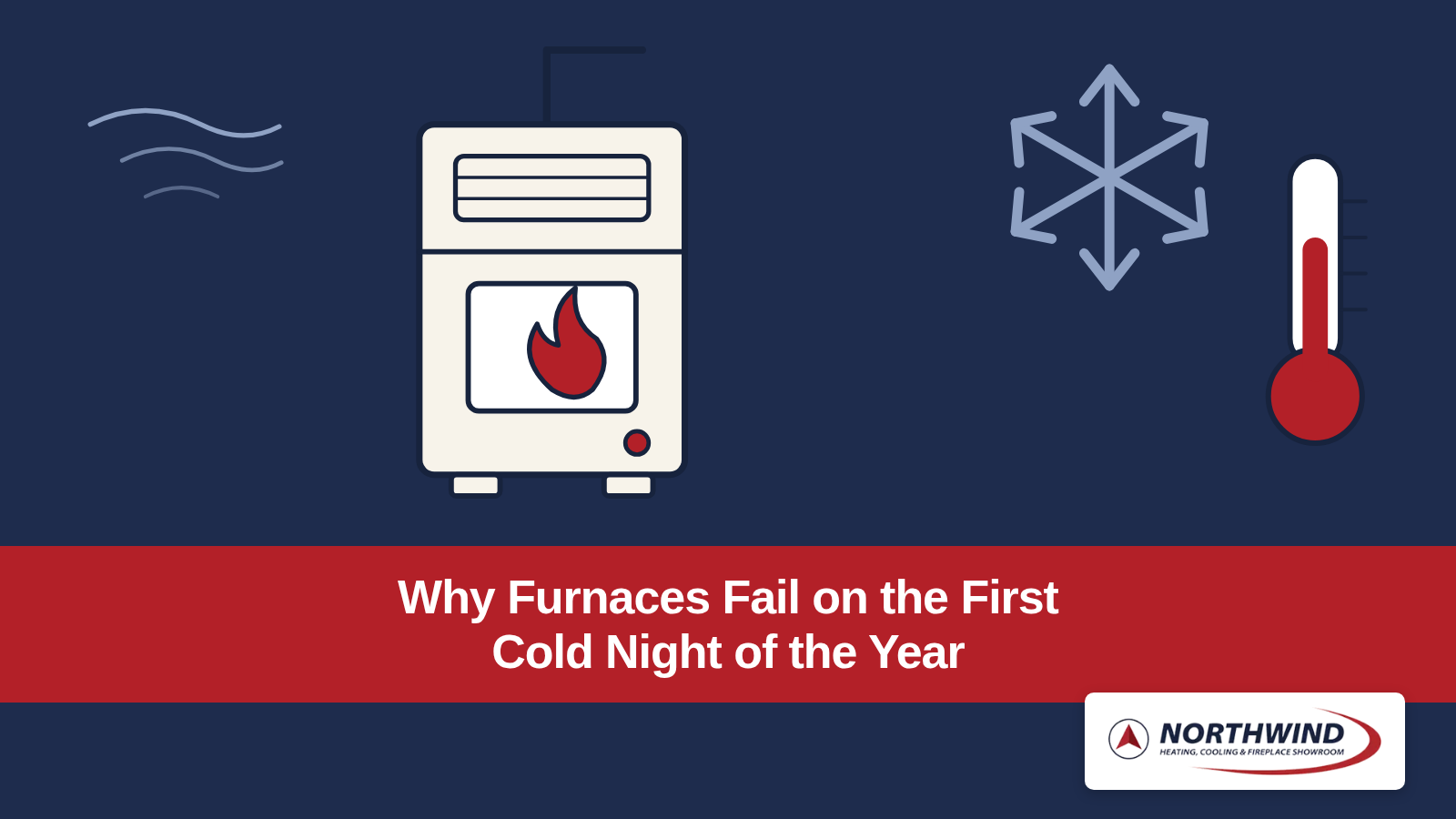
The answer is that nothing failed on the cold night. Something failed months earlier, and the cold night is simply the first time anyone asked the furnace to prove it still worked.
Six months of sitting idle
A Lower Mainland furnace typically does very little between May and October. Our summers are mild enough that many homes shut the heating off entirely. During those months several things happen quietly.
• Dust settles on the flame sensor, in the burner assembly and across the blower wheel.
• Bearings and motors sit still, and lubricant migrates away from where it is needed.
• Igniters cool and contract repeatedly through the shoulder season, and hot surface igniters are brittle by nature.
• Capacitors age whether the unit runs or not, losing capacity gradually until they can no longer start a motor under load.
None of this produces a symptom while the furnace is off. It produces a symptom the moment full demand arrives.
The first call is the hardest one
The other factor is the nature of that first run. On a mild autumn evening a furnace might cycle briefly. On the first properly cold night it runs long and hard, often for the first sustained period since spring. Components that were marginal cope with a short cycle and fail under a long one.
This is why a furnace can seem fine during a brief test in September and then fail in November. A two-minute test run is not the same demand as a four-hour one.
Our climate makes it worse, not better
There is a counterintuitive point here. Homeowners often assume a mild coastal climate is easy on heating equipment. In terms of total workload it is. But the long idle period and the frequent short-cycling through our extended shoulder seasons are genuinely harder on ignition components and controls than a colder region where the furnace starts in October and simply runs.
Damp air through the idle months adds corrosion on burners, heat exchanger surfaces and electrical contacts. A furnace in a drier, colder climate often lives an easier mechanical life than one in Surrey.
What Actually Fails
The same small group of components accounts for the large majority of first-cold-night calls.
The flame sensor
This is the most common single cause, and one of the least expensive to fix. The flame sensor is a thin metal rod that sits in the flame and confirms to the control board that ignition actually happened. Over time it develops a film of oxidation and residue. Once the film is thick enough, the board no longer registers a flame, shuts the gas off as a safety measure, and tries again.
The signature is unmistakable: the furnace lights, runs for a handful of seconds, shuts down, and repeats the cycle several times before locking out entirely.
The igniter
Hot surface igniters are brittle and have a finite number of heat cycles in them. They typically fail cold, meaning they were fine at the end of last season and simply do not glow when asked. There is often no warning at all.
The capacitor
Capacitors give the blower motor the initial push it needs to start. They degrade steadily with age. A weak capacitor may start the motor on a mild day and fail to start it when the motor is cold and being asked for sustained output.
A blocked or filthy filter
A filter left in place since spring restricts airflow enough that the heat exchanger overheats and the limit switch shuts the furnace down for protection. It is the easiest problem on this list to prevent and one of the most frequent.
Condensate drainage
High-efficiency condensing furnaces produce water as a by-product. Over a long idle summer the condensate trap and drain line can accumulate sediment or biological growth. When the furnace fires for the season and the drain backs up, the pressure switch or float safety shuts it down.
The Five-Minute Checklist Before You Call
Work through these before booking. A meaningful proportion of no-heat calls resolve here.
• Thermostat. Confirm it is set to Heat, that the setpoint is above room temperature, and, if it is battery powered, replace the batteries. Flat thermostat batteries are a genuinely common cause.
• Power. Check the breaker for the furnace, and check the service switch on or beside the unit, which looks like an ordinary light switch and gets knocked off surprisingly often.
• Filter. Pull it out and look at it against a light. If it is grey and you cannot see through it, replace it.
• Gas. Confirm other gas appliances are working, which tells you whether the problem is the furnace or the supply.
• Furnace door. The access panel has a safety switch. If the panel is not seated properly, the furnace will not run at all.
• Condensate. Look for standing water around the base of the unit, which suggests a blocked drain.
If all six check out, the fault is internal and needs a technician. Note down what the furnace does — whether it tries to light, how many times, what you hear — because that description shortens the diagnosis considerably.
What Not to Do
• Do not repeatedly reset a furnace that has locked out. Lockout is a safety response. Forcing it through cycle after cycle can put unburnt gas into the heat exchanger.
• Do not use the oven or a gas range for heat. They are not designed for it and they are not vented for it.
• Do not ignore a burning smell that persists beyond the first few minutes of the season. A brief dust smell on the first run is normal. A continuing smell is not.
• Do not run space heaters on extension cords as a stopgap, which is a common cause of house fires during cold snaps.
If you smell gas at any point, leave the building and call the emergency line for your gas utility before calling anyone else.
How to Not Be in This Position Next Year
Almost every failure described here is detectable before it strands you. A pre-season service cleans the flame sensor, tests the igniter, measures capacitor capacity against its rating, clears the condensate trap and confirms the furnace runs properly under sustained demand rather than for thirty seconds.
The timing matters as much as the service itself. September and early October are when appointments are available. From the first cold week onward, every heating company in the Lower Mainland is working through emergency calls, and routine maintenance moves to the back of the queue.
If your furnace is beyond the point where maintenance is the answer, that is a better conversation to have in autumn than in the middle of January. Our gas furnace page covers replacement, and a heat pump is worth considering at the same time if you would also like cooling in summer. Where budget is the constraint, financing is available.
Most of this is avoidable with a short changeover routine in September, which we set out in our guide to shutting down the air conditioning and waking the furnace.
Frequently Asked Questions
Why does my furnace only fail when it gets cold?
Because the cold night is the first time it has been asked for sustained output since spring. Components degrade quietly through six months of idleness — dust on the flame sensor, an ageing capacitor, a brittle igniter — and none of that produces a symptom until the furnace runs hard. The failure was developing for months; the cold night simply revealed it.
My furnace starts then shuts off after a few seconds. What is that?
That pattern almost always indicates a dirty flame sensor. The furnace lights correctly, but the sensor cannot confirm the flame to the control board, so the board shuts the gas off as a safety measure and retries. After several attempts it locks out. Cleaning or replacing the sensor is an inexpensive repair.
Can I clean the flame sensor myself?
It is possible, but it means opening a gas appliance, and doing it incorrectly risks damaging the sensor or disturbing the burner assembly. Given that it is a low-cost repair for a technician who will also check why the residue built up, we would not recommend it as a DIY job.
How long does a furnace last in the Lower Mainland?
Fifteen to twenty years is typical for a well-maintained unit, and our mild climate means lower total run hours than colder regions. The more useful indicators than age alone are repair frequency, rising energy use for the same comfort, and whether replacement parts are still readily available for the model.
Should I book furnace maintenance every year?
Yes, and ideally before the heating season rather than during it. An annual service addresses the exact components that cause first-cold-night failures, and booking it in September or early October means you get an appointment at a time of your choosing rather than joining an emergency queue.
Is it worth repairing an older furnace or replacing it?
A useful test is comparing the repair cost against the unit's remaining expected life. A single inexpensive repair on a twelve-year-old furnace is usually worth doing. A significant repair on an eighteen-year-old unit that has needed attention in each of the last few seasons is money spent on borrowed time, particularly if you would want cooling as well and could address both with one system.
Getting Ahead of It
The first cold night is entirely predictable. What is avoidable is being on the wrong end of it.
Northwind Heating, Cooling & Fireplace Showroom has been keeping Lower Mainland homes warm since 1989, across Surrey, Langley, Delta, White Rock and the surrounding communities. Get in touch to book a pre-season service while there is still room in the calendar, or call us if your heat is already out.
Other Blog Posts
Customer Testimonials
Go With Experience

I cannot recommend this company enough. We were horribly jerked around by Angels Heating and Cooling. Northwind took the time to answer all our questions, we're professional, timely, affordable and sent a great technician to fix our gas fireplace.
We had a duel fuel system installed by Northwind. Our experience from installation to post installation service has been amazing.
Our fireplace had not been working. This was the only company that was willing to come out. Wes the technician was great. Diagnosed the problem and fixed it. Spoke to Deanna on the phone. She has awesome customer service skills. I would use them again and highly recommend them.
A+ Customer Service! We had a minor issue and they stopped by right away. We've used them on residential and commercial buildings and they are always on top of everything. Thank you to Chris as well!
We purchased and had Nothwind install a Valor gas fireplace for us. They did an excellent job. We did have a problem with the remote control that came with the unit but were very happy with the immediate response and repair from Northwind for warranty work.
I’ve been in the construction business for many years and the Northwind HVAC crew for sure rank up there in the number one spot. Without exception, all the work was carried out swftly, with journeyman style and with a friendly contractor/client relationship.
Home
Blogs