
Your Air Conditioner Is Not Broken Because It Will Not Stop Running
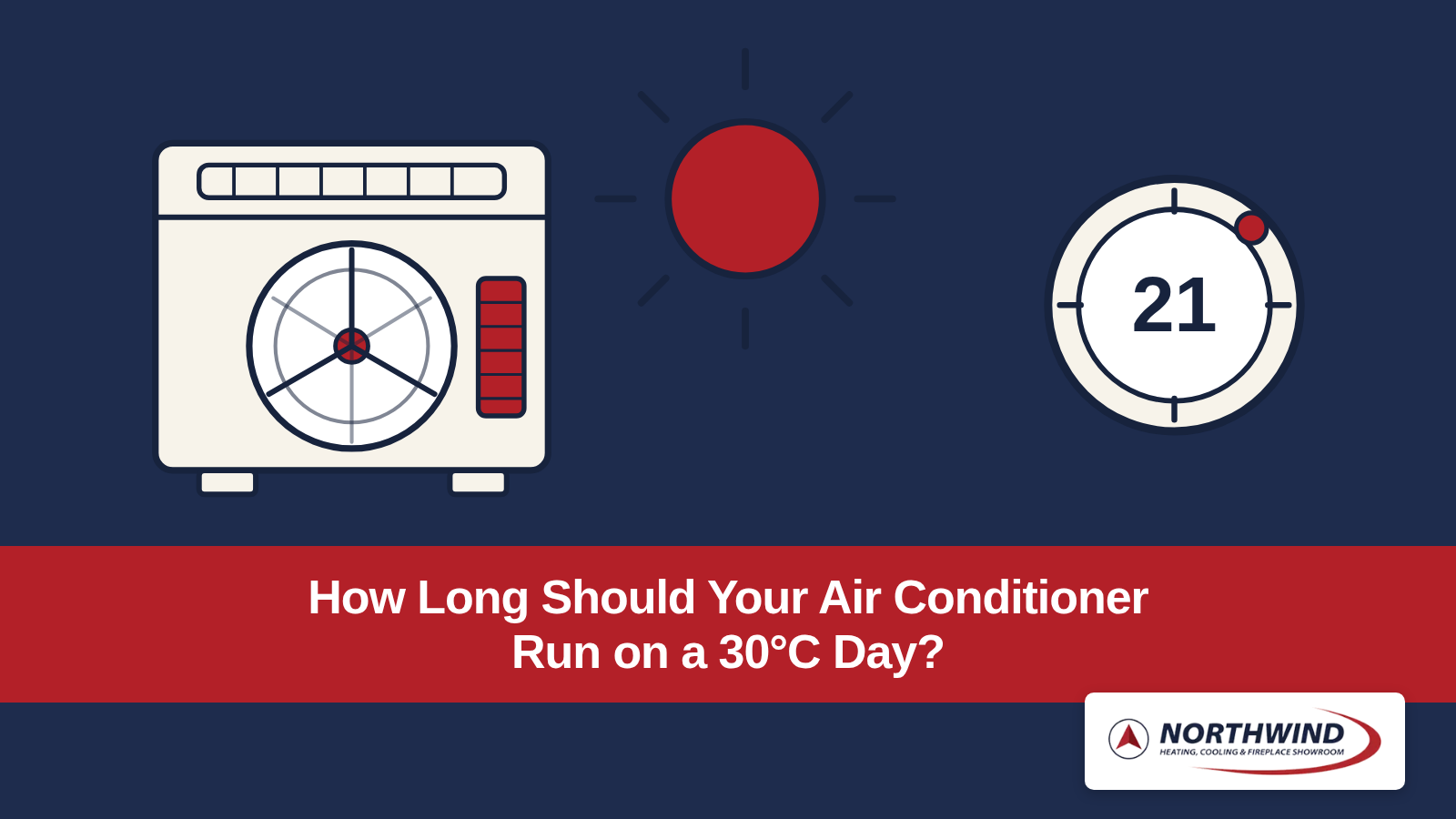
If you are researching How Long Should Your Air Conditioner Run on a 30°C Day?, there is a fair chance you are listening to the outdoor unit hum away for the third hour straight and wondering what has gone wrong. It is one of the most common questions we field in June.
Most homeowners have this backwards. Long run times usually mean the system is sized correctly for the house it sits in. The real warning sign is the opposite: a unit that fires up, blasts cold air for eight minutes, shuts down, and repeats all afternoon. That is short cycling, and it wears out equipment while leaving the house damp.
Because our summers used to be forgiving, much of the cooling equipment around Surrey, Langley, Delta and White Rock was sized by rule of thumb rather than calculation, and a good deal of it is oversized. When our team at Northwind Heating, Cooling & Fireplace Showroom is called to a system that runs constantly, the answer is often that nothing needs fixing.
What a Normal Cooling Cycle Looks Like
A cycle is one complete on-and-off sequence: the thermostat calls, the compressor and blower run until the setpoint is met, then everything rests. Cycle length depends almost entirely on how hard the outdoors is pushing heat in.
Mild days, short cycles
At 20°C to 22°C the load is small, so expect brief runs with long gaps. This is the one situation where short cycles are appropriate, though runs of only a few minutes are still worth noticing.
Warm days, longer runs
Somewhere in the mid twenties, cycles stretch out and the gaps shrink — typically fifteen to twenty-five minutes on, with a similar rest. Late afternoon runs are longer, because the building has absorbed solar gain all day and is releasing it back inside.
Hot days, near-continuous operation
At 30°C and above, a correctly sized system runs for very long stretches, and on the hottest afternoon of the year it may not shut off at all between midday and early evening. That is not a fault; it is the equipment doing the job it was sized for.
Why Correct Sizing Means Running Almost Constantly
Cooling equipment is not sized for the average day. It is sized against a design temperature and matched to your house: window area and orientation, insulation, air leakage, ceiling height.
The system is meant to just barely keep up
A good sizing calculation lands on capacity roughly equal to the home's heat gain at design conditions, so at that temperature run time approaches continuous. Any smaller and the house drifts warm; any larger and you have paid for capacity that causes the problems below.
The differential, not the number you dial in
On a 30°C day, a system holds a roughly fixed differential below the outdoor temperature rather than reaching whatever figure you select — for many homes, ten to fifteen degrees below outdoors when running continuously. Dialling in 19°C on a 33°C afternoon does not make it try harder, it only guarantees it never rests. If some rooms never keep up whatever the setpoint, that is distribution rather than capacity, and our guide to rooms that stay stubbornly warmer than the rest of the house covers where to look.
Oversizing and the Cold, Clammy House
An air conditioner does two jobs: it lowers air temperature, and it strips moisture from the air passing over the cold indoor coil. The first happens quickly. The second needs time.
Dehumidification only starts once the coil is properly cold
On start-up, the coil takes several minutes to reach the temperature at which water vapour condenses out and drains away, so a unit that stops after eight minutes has cooled the air without drying it. That is the oversized system's complaint: the thermometer reads 22°C, the air feels heavy and sticky, and nobody is comfortable. In our damp coastal climate the honest fix is often to raise the setpoint a degree so each run lasts longer.
There is no adjustment that fixes it
Nothing makes an oversized compressor behave like a right-sized one. Variable-capacity and two-stage equipment sidesteps it by running at reduced output for long periods, which suits our climate. If replacement is on the horizon, our notes on getting the sizing calculation and installation timing right ahead of summer explain why it matters more than the model number.
Short Cycling, and What Causes It
Short cycling means the compressor stops and starts far more often than the load justifies — repeated runs of a few minutes on a genuinely hot day. Starting a compressor is the hardest thing it does, so frequent starts shorten its life and worsen comfort. Common causes:
• Restricted airflow. A blocked filter or closed returns starve the coil of warm air, so it gets too cold too fast and the system trips off on its safeties.
• Low refrigerant charge. A leak reduces capacity and causes pressure-related shutdowns that look like brief, erratic cycles.
• Dirty coils. Fouled surfaces cannot transfer heat properly, pushing operating pressures out of range.
• Thermostat placement. One in direct sun, above a lamp or near a supply register reads a false temperature and satisfies early.
• Oversized equipment. Capacity well beyond the load satisfies the thermostat before a full cycle completes.
Start with the filter and the outdoor unit
Airflow is the most common cause and the cheapest to rule out. A filter too restrictive for the equipment, or overdue for changing, produces exactly these symptoms, and our piece on matching filter rating to what your air handler can actually pull air through covers the trade-off. Then walk the outdoor unit: hedging, fence panels and stacked furniture restrict the air the condenser needs.
When to stop troubleshooting
If the filter is clean, the condenser clear and it still cycles rapidly, the remaining causes are refrigerant, controls or sizing. Those need gauges, not guesswork, and resetting a system that keeps tripping a safety turns a small repair into a large one.
What Genuinely Indicates a Problem
Set run length aside and watch these four signs instead.
It never reaches setpoint, even overnight
Falling behind during a 33°C afternoon is normal. Failing to catch up after midnight, once it is into the teens outside, is not. A house still warm at six in the morning has lost capacity somewhere.
Ice on the refrigerant lines or indoor coil
Visible frost on the insulated copper line outside, or on the coil above the furnace, means something is wrong now — almost always restricted airflow or low charge. Switch to fan-only to thaw it and book service, since running a frozen system risks liquid refrigerant reaching the compressor.
Indoor humidity climbing while the system runs
If the air feels heavier through the afternoon despite steady cooling, the system is moving temperature but not moisture. That points to short cycles, oversizing, or air crossing the coil too fast for condensation to form. An inexpensive hygrometer is worth owning.
A big, unexplained jump in run time year over year
This is the strongest early warning of all. If last July the system rested for part of each hour on a 30°C day and this July it never stops in the same weather, capacity has degraded. Refrigerant loss, a fouled condenser or a tired capacitor show up first as creeping run time.
If your system is running constantly and still not bringing the temperature down, that is a different problem from the one described here, and our guide to what to check when an air conditioner is not cooling walks through the likely causes in order.
Frequently Asked Questions
How long should an air conditioner run on a hot day?
On a 30°C day a correctly sized air conditioner will typically run for long stretches, often most of the afternoon, and on the hottest day of the year it may run almost continuously. Equipment is sized so its capacity roughly matches the home's heat gain at design conditions, which makes that the intended behaviour. Shorter cycles are normal on mild days.
Is it bad if my AC runs all day?
No, an air conditioner running for hours during a heat event is normal and generally indicates correct sizing rather than a fault. Continuous operation also gives better humidity control, because the coil stays cold long enough to condense moisture out of the air. What matters is whether the house holds steady through the day and recovers overnight.
Why does my AC turn on and off every few minutes?
Frequent short cycles usually mean restricted airflow, low refrigerant charge, a poorly placed thermostat, or equipment oversized for the home. A blocked filter or closed returns are the most common cause and the easiest to check. It is genuinely harmful, because compressor starts cause the most wear and brief runs leave humidity behind.
Why is my house cold but still damp?
A house that is cool and clammy at once almost always has an oversized air conditioner that satisfies the thermostat before running long enough to remove moisture. Dehumidification begins only once the coil has been cold for several minutes, so short runs cool the air without drying it. Raising the setpoint a degree or two lengthens each cycle and usually helps.
How cold should my house be compared to outside?
Most residential systems hold roughly ten to fifteen degrees below the outdoor temperature when running continuously in a reasonably tight house, so on a 33°C afternoon an indoor temperature in the low twenties is realistic. The equipment maintains a differential rather than reaching any number you select. Setting the thermostat lower adds no capacity — shading sun-facing windows does more.
When should I be worried about my air conditioner?
Call for service if the system never reaches setpoint even overnight, if there is ice on the refrigerant lines or coil, if indoor humidity rises while it runs, or if run time has jumped sharply against last summer in similar weather. Those signs point to lost capacity, restricted airflow or refrigerant loss. Run length alone is not a symptom.
The Short Version
A system that runs for hours on the hottest afternoon of the year is doing its job. One that starts and stops every few minutes, leaves the house damp, ices up or quietly runs longer each summer is telling you something. Watch the pattern rather than the clock.
Northwind Heating, Cooling & Fireplace Showroom has been installing and servicing heating, cooling, heat pumps, ductless systems, fireplaces, water heaters, outdoor heating and indoor air quality equipment across Surrey, Langley, Delta, White Rock and the Lower Mainland since 1989, and is a registered CleanBC contractor. If your system is short cycling, struggling in heat events or due for a look, our air conditioning installation and service team can measure what it is actually doing rather than guess. Get in touch and we will take a look.
Other Blog Posts
Customer Testimonials
Go With Experience

I cannot recommend this company enough. We were horribly jerked around by Angels Heating and Cooling. Northwind took the time to answer all our questions, we're professional, timely, affordable and sent a great technician to fix our gas fireplace.
We had a duel fuel system installed by Northwind. Our experience from installation to post installation service has been amazing.
Our fireplace had not been working. This was the only company that was willing to come out. Wes the technician was great. Diagnosed the problem and fixed it. Spoke to Deanna on the phone. She has awesome customer service skills. I would use them again and highly recommend them.
A+ Customer Service! We had a minor issue and they stopped by right away. We've used them on residential and commercial buildings and they are always on top of everything. Thank you to Chris as well!
We purchased and had Nothwind install a Valor gas fireplace for us. They did an excellent job. We did have a problem with the remote control that came with the unit but were very happy with the immediate response and repair from Northwind for warranty work.
I’ve been in the construction business for many years and the Northwind HVAC crew for sure rank up there in the number one spot. Without exception, all the work was carried out swftly, with journeyman style and with a friendly contractor/client relationship.
Home
Blogs