
The Patio Is Lovely Until About Nine O'Clock
If you are researching Patio Heaters and Outdoor Gas Lines: What BC Homeowners Should Know, you have probably already had the evening that starts the search. Dinner outside in June, and then the sun drops behind the trees and everybody drifts indoors an hour earlier than they wanted to. Here that pattern holds from May through September, and it is the reason most outdoor heating gets bought.
The options are not complicated, but they are genuinely different, and the right one depends far more on where the appliance is going than on how much heat it makes. An open deck, a covered patio and a strata balcony are three different problems. The dangerous version of getting it wrong — a propane heater running under a roof — is also the one people are most confident about.
What follows is how our team at Northwind Heating, Cooling & Fireplace Showroom thinks about outdoor heating for homes in Surrey, Langley, Delta and White Rock: the four realistic options, the clearances that decide most installations, and the strata and permitting realities that catch people out.
The Four Realistic Options
Portable propane heaters
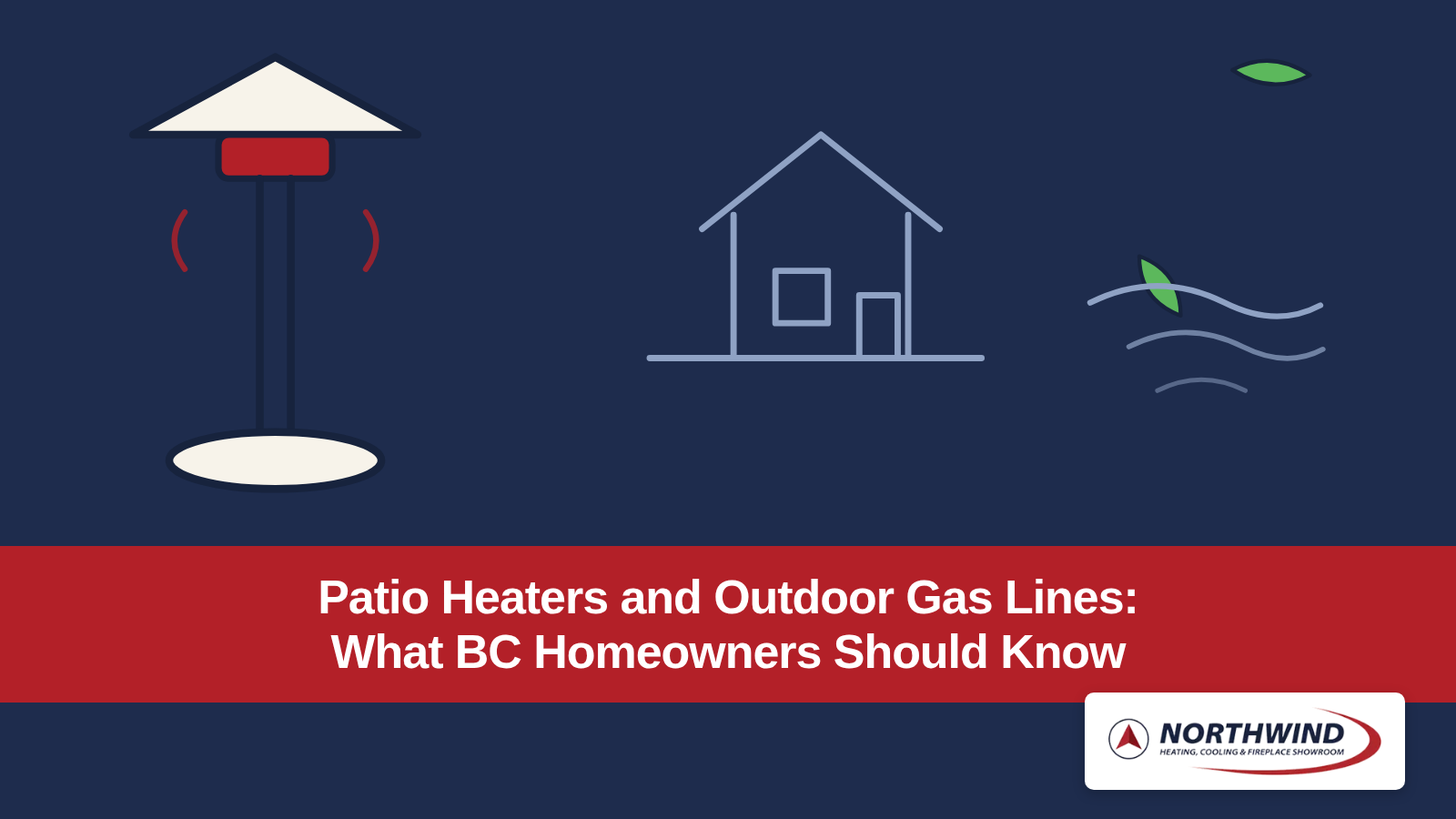
The tall mushroom heater with a tank in the base is the default because it is sold everywhere. No installation, it goes where you want it, and it is the cheapest way to find out whether you will use outdoor heating at all. The drawbacks arrive with use: buying, exchanging and storing tanks, poor stability in wind, and heat thrown in a circle rather than where people sit. It is also an open flame, which puts hard limits on where it can stand.
Fixed natural gas heaters
These are permanently mounted units — overhead, or on a post or wall — plumbed to the gas supply already coming into the house. No tanks, no refilling, no storage. They cost more up front, because running and sizing a line to the patio is real work. What you buy is an appliance that actually gets used, because using it takes no effort.
Electric infrared heaters
Electric infrared units mount overhead or on a wall and warm people and objects directly rather than heating the air, which is the sensible approach outdoors where the air will not stay warm regardless. They respond instantly and involve no combustion, no flame and no exhaust gases. That is why infrared is the standard answer for covered patios, screened porches and apartment balconies.
Fire tables and outdoor fireplaces
Fire tables, fire bowls and built-in outdoor fireplaces do a different job. They give off some warmth, but their real function is to be the thing people gather around — nobody sits facing a patio heater. Gas versions can be plumbed to the same line that feeds a heater, which is worth knowing before any trenching happens. Wood-burning versions are more work and more affected by seasonal fire restrictions.
Why a Fixed Gas Line Is the Better Long-Term Answer
For a patio that gets regular use, a permanent natural gas line is what we recommend most often.
You stop managing fuel
Tank management is why portable heaters go unused, and removing that friction decides whether an outdoor space gets used in shoulder season. There is also nothing to store, which matters more than people expect once you read the section on strata rules below. A fixed unit is mounted, aimed and weather-rated for where it lives, so it does not blow over and is not put away each autumn.
One line can serve several appliances
Once a properly sized line reaches the patio it can feed a heater, a fire table, an outdoor kitchen burner or a barbecue outlet. The expensive part is getting gas from the house to the patio — trenching, routing, penetrating the building envelope. Doing that once, sized for what you might add in five years rather than only what you are installing today, is far cheaper than doing it twice.
Covered Balconies: Why Electric Usually Wins
Covered outdoor space is where the advice reverses.
Combustion products need somewhere to go
Any gas or propane appliance produces combustion products. In the open they disperse harmlessly. Under a roof, against a wall, on a balcony with a solid ceiling and railings, they do not disperse the way people assume — and carbon monoxide is odourless. That is the core reason unvented combustion appliances carry restrictions on enclosed and semi-enclosed spaces.
The real constraint is the circuit
Check the electrical supply before choosing a model. Many outdoor infrared heaters expect a dedicated circuit, and balconies in buildings from the 1970s through the 1990s often have one shared convenience outlet, if they have one at all. On a strata balcony, adding a circuit is rarely simple.
Clearances Are the Part People Get Wrong
Every heater is certified with minimum clearances to combustible materials, published by the manufacturer for that model. We will not invent numbers, because they differ meaningfully between models and the label on your unit is the only figure that matters. What we can tell you is which clearances get overlooked.
• Overhead structures. Ceilings, roof decking, pergola beams and soffits above a heater are the most ignored clearance and the most consequential, because heat rises into them continuously.
• Awnings and umbrellas. Fabric above or beside a heater is combustible, it moves in wind, and a retractable awning can be extended over a heater that was safely placed when it was closed.
• Railings and furniture. Side clearances matter for wall and post-mounted units, and cushions and stacked chairs migrate towards heat as the evening cools.
• Traffic paths. A hot unit at head height, or a tall heater beside a doorway where it can be knocked over, is a hazard independent of any clearance table.
Propane under a covered patio
This is the most common serious mistake, and it deserves stating plainly: a portable propane heater should not be run under a covered patio, in a gazebo, on a balcony with a ceiling, or in any partly enclosed space. These appliances are certified for outdoor use in the open. Under cover you have an open flame close to a combustible ceiling and combustion products collecting in a space that does not clear the way open air does. It is done constantly, it usually goes fine, and when it does not the consequences are severe.
Strata Rules and Seasonal Fire Bans
Strata bylaws usually name propane directly
If you live in a strata, read the bylaws before buying anything. Many strata corporations in the Lower Mainland prohibit propane cylinders on balconies and in storage lockers outright, which rules out portable heaters and most fire bowls however carefully you intend to use them. Mounting anything to a ceiling, wall or railing is usually an alteration to common property as well, needing written approval before the work.
Fire bans are a real constraint
Through the drier part of summer, fire restrictions are issued periodically across the region and can apply to wood burning and some open-flame appliances. The rules and boundaries change year to year and between jurisdictions, so check what is currently in effect with your local authority before lighting anything. This is another point in favour of fixed gas and electric appliances.
Permits and Doing It Once
A new gas line is permitted work
Running a new gas line to a patio, extending an existing one, or connecting a fixed outdoor gas appliance is regulated work requiring a gas permit and a licensed gas fitter. Unpermitted gas work creates insurance problems, complicates the sale of a home, and skips the inspection that catches sizing and venting errors. Who issues the permit varies by municipality, and we have set that out in our guide to HVAC and gas permits in Surrey, Langley and Delta rather than repeating it here.
Sizing is not guesswork
Adding a patio appliance means the existing supply has to carry the extra load alongside the furnace, water heater, range and any indoor fireplace. Sometimes it does comfortably; sometimes the line needs upsizing. That calculation is part of a proper installation, and it is one reason a site visit precedes any quote. Book earlier than feels necessary, too — trenching, mounting and inspection all take calendar time once demand climbs in late spring.
Frequently Asked Questions
Can I use a propane patio heater under a covered patio?
No — portable propane patio heaters are certified for open outdoor areas only and should not be operated under a roof, in a gazebo, or on a covered balcony. The risks are a naked flame near a combustible ceiling and combustion products, including odourless carbon monoxide, collecting in a space that does not ventilate like open air. For covered spaces, electric infrared is the appropriate choice.
Is a natural gas patio heater better than propane?
For a patio you use regularly, yes — a fixed natural gas heater plumbed to the house supply removes tank refilling and storage entirely and is far more likely to get used. Propane suits occasional use, renters, and anyone testing the idea before committing. The trade-off is that natural gas needs a permitted installation by a licensed gas fitter.
How much does it cost to run a gas line to a patio?
The cost depends almost entirely on the distance from the existing gas supply to the patio and what the line has to cross to get there. A short run through an exterior wall on the meter side of the house is straightforward; a run under a driveway or across a finished basement is not. Whether the existing supply can carry the extra load also matters, so any credible figure comes from a site visit.
Do I need a permit for an outdoor gas heater in BC?
Yes — installing a new gas line or connecting a fixed gas appliance requires a gas permit and must be carried out by a licensed gas fitter. The permitting authority depends on your municipality. A portable propane heater connected to a cylinder is not permitted work, which is part of why portables are so common. Unpermitted gas work can affect home insurance and typically surfaces during a sale.
Are propane heaters allowed on strata balconies?
Frequently not — many strata corporations prohibit propane cylinders on balconies and in storage areas altogether, which makes portable heaters and most fire bowls a non-starter. Read your bylaws before buying, and remember that mounting anything to a balcony ceiling, wall or railing usually needs written approval. Electric infrared is generally the option that will be permitted, subject to available power.
What is the safest patio heater for a covered deck?
An electric infrared heater mounted overhead or on a wall is the safest option for a covered deck, because it produces no flame and no combustion by-products. Follow the manufacturer's clearance specifications for that model, particularly the distance to the ceiling and to any awning or fabric shade. Confirm the electrical supply first, since many models expect a dedicated circuit a deck may not have.
Where to Start
If you are unsure, start with the space rather than the appliance. Is it open to the sky or covered? Is there gas at the house, and how far is the meter from the patio? Is there usable power out there, and does a strata have a say? Those answers narrow the field almost immediately.
If you are testing the idea, a portable propane heater on an open deck is a reasonable first step, provided it stays out from under any roof. If the patio is already part of how you live from May to September, put the money into a fixed installation and stop thinking about it.
Northwind Heating, Cooling & Fireplace Showroom has been installing and servicing heating, cooling, fireplaces and outdoor equipment across Surrey, Langley, Delta, White Rock and the Lower Mainland since 1989, and we are a registered CleanBC contractor. If you would like someone to look at the patio, confirm what your gas supply can carry, and talk through outdoor heating options or an outdoor fireplace alongside them, Get in touch and we will arrange a visit.
Other Blog Posts
Customer Testimonials
Go With Experience

I cannot recommend this company enough. We were horribly jerked around by Angels Heating and Cooling. Northwind took the time to answer all our questions, we're professional, timely, affordable and sent a great technician to fix our gas fireplace.
We had a duel fuel system installed by Northwind. Our experience from installation to post installation service has been amazing.
Our fireplace had not been working. This was the only company that was willing to come out. Wes the technician was great. Diagnosed the problem and fixed it. Spoke to Deanna on the phone. She has awesome customer service skills. I would use them again and highly recommend them.
A+ Customer Service! We had a minor issue and they stopped by right away. We've used them on residential and commercial buildings and they are always on top of everything. Thank you to Chris as well!
We purchased and had Nothwind install a Valor gas fireplace for us. They did an excellent job. We did have a problem with the remote control that came with the unit but were very happy with the immediate response and repair from Northwind for warranty work.
I’ve been in the construction business for many years and the Northwind HVAC crew for sure rank up there in the number one spot. Without exception, all the work was carried out swftly, with journeyman style and with a friendly contractor/client relationship.
Home
Blogs