
The Appliance Nobody Thinks About Until It Leaks
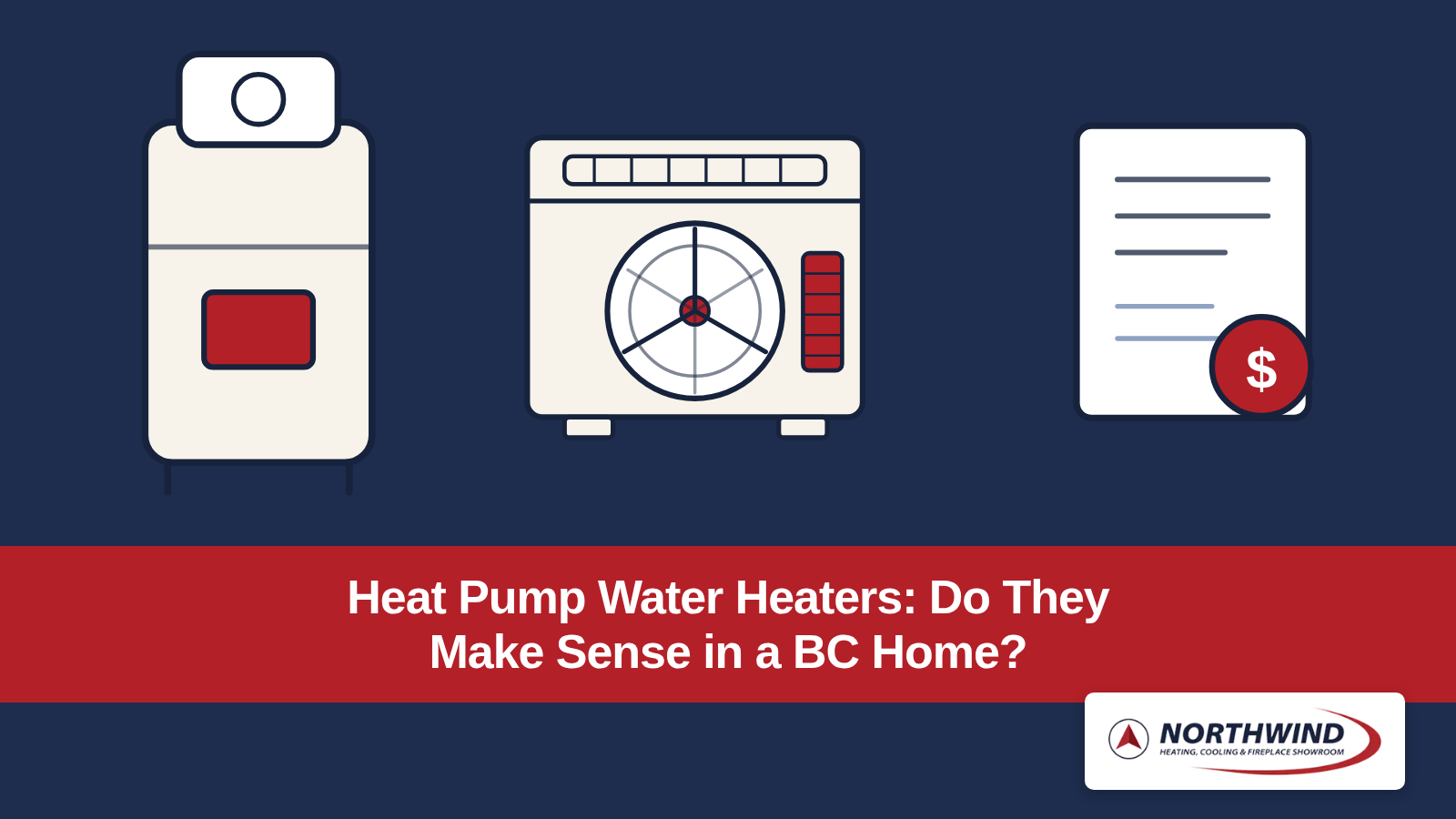
If you are researching Heat Pump Water Heaters: Do They Make Sense in a BC Home?, you are probably in one of two situations. Either your existing tank is old enough to worry you, or someone has mentioned heat pump water heaters and you are trying to work out whether the claims are real.
They are real, with conditions. A heat pump water heater genuinely uses a fraction of the electricity of a conventional electric tank, and our team at Northwind Heating, Cooling & Fireplace Showroom installs them where they suit the house. But they are not a drop-in replacement for every tank in every basement, and the conditions that make them work are physical rather than financial.
This guide covers how they work, which homes suit them, and the specific reasons they are the wrong choice in some.
How They Work
A conventional electric water heater turns electricity directly into heat through resistance elements. It is simple and it is roughly a one-to-one conversion.
A heat pump water heater instead moves heat rather than creating it. A small heat pump on top of the tank draws warmth out of the surrounding air and transfers it into the water, using electricity to run the compressor rather than to generate the heat itself. Because it is moving existing heat instead of making new heat, it delivers considerably more hot water per unit of electricity than a resistance tank.
Nearly all models include backup resistance elements for heavy demand, and most offer a mode that runs on the heat pump alone.
The consequence people miss
Taking heat out of the surrounding air has two side effects, and they decide whether the appliance suits your home.
The space around the tank gets cooler, and it gets drier, because the unit condenses moisture out of the air as it works. In a damp Lower Mainland basement or garage, that dehumidification is frequently a benefit rather than a drawback. In a small heated utility closet, it is a problem.
Which Homes They Suit
You need the right space
This is the first filter and it is not negotiable. The unit needs a reasonable volume of air to draw from — manufacturers typically specify a minimum room size, commonly in the region of several hundred cubic feet — or a louvered door or duct arrangement that gives it access to a larger space.
An unfinished basement, a garage or a large utility room usually qualifies. A tight closet does not, unless it can be ducted or louvered.
The space needs to stay reasonably warm
Efficiency falls as the surrounding air gets colder, because there is less heat available to move. In the Lower Mainland this is far less of an obstacle than in colder parts of Canada — our garages and basements rarely approach the temperatures where these units struggle — but an unheated, poorly insulated space at the cold end of winter will see reduced performance and more backup element use.
You need a drain and a condensate path
Because the unit produces condensate, it needs somewhere for that water to go. A floor drain or condensate pump is required. This is straightforward but it is a real installation consideration and a common reason a location gets ruled out.
The economics work best replacing electric
If you currently have a conventional electric tank, a heat pump water heater is a clear efficiency improvement and the case is easy. If you have a gas water heater, the comparison is more nuanced and depends on the relative cost of gas and electricity, your household's hot water use, and whether you want to reduce gas appliances in the home. It is worth working through the actual numbers rather than assuming.
Where They Are the Wrong Choice
An honest list, because installing one in the wrong place produces an unhappy owner.
• A small heated closet with no ducting option. The unit will cool a space you are paying to heat, and it may not have enough air to work properly.
• A finished space adjacent to a bedroom. These are louder than a conventional tank — a compressor and fan running rather than silence. Not loud, but not nothing.
• Where there is no drain and no practical route for a condensate pump.
• Very high simultaneous demand in a large household. The heat pump recovers more slowly than resistance heating, so the unit leans on its backup elements, which erodes the efficiency advantage. Sizing matters more than with a conventional tank.
• Tight installations, since these units are physically taller than the tanks they replace and need clearance above.
What to Expect in Practice
They are taller
The heat pump sits on top of the tank, so a like-for-like capacity replacement takes more headroom. Measure before committing, particularly in a basement with low joists.
They make noise
Roughly comparable to a quiet dishwasher, and intermittent rather than constant. In a garage or unfinished basement this is a non-issue. Under a bedroom floor it is worth thinking about.
Recovery is slower
In heat-pump-only mode the tank reheats more slowly than a resistance or gas tank. Most households never notice, because recovery happens between demands rather than during them. Households with heavy back-to-back use notice it, which is why capacity should be specified generously.
They need occasional attention
The air filter on the heat pump section needs periodic cleaning, and the condensate drain should be checked. Neither is onerous, but a conventional tank asks nothing of you and this one does. It is the same category of small annual attention as the rest of your equipment, and worth folding into a service agreement rather than remembering separately.
Rebates
Heat pump water heaters are a supported category in British Columbia, and rebates have been available through provincial and utility programmes. Amounts and eligibility conditions change from year to year, and some require installation by a registered contractor, so the relevant question is what is available at the time you are buying rather than what was available last year.
Our rebates page covers what is current, and our guide to BC heat pump rebates explains how the programme tiers generally work. As with any rebate, confirm eligibility before choosing equipment rather than after.
How This Fits a Larger Plan
One point worth making. If your furnace is also approaching the end of its life, it is worth considering the water heater and the heating system together rather than replacing them two years apart.
Electrical capacity is the reason. A heat pump for space heating and a heat pump water heater both add electrical load, and the time to establish whether your panel can carry both is before you commit to either. Discovering it after the first installation is an expensive sequence. Our comparison of heat pumps and gas furnaces covers the space heating side of that decision, and the same argument for planning ahead applies here as in our post on planning an install in spring.
Frequently Asked Questions
Are heat pump water heaters worth it in BC?
Usually yes if you are replacing a conventional electric tank and have a suitable space, because they use substantially less electricity for the same hot water. The comparison against a gas tank is less clear cut and depends on relative energy costs and household demand. The deciding factor is normally whether you have somewhere appropriate to put one.
How much space does a heat pump water heater need?
Manufacturers typically specify a minimum room volume, commonly in the range of several hundred cubic feet, because the unit draws heat from the surrounding air. An unfinished basement, garage or large utility room generally qualifies. A small closet does not, unless it has louvered doors or ducting to a larger space.
Do heat pump water heaters work in a cold garage?
In the Lower Mainland, generally yes, though efficiency drops as the surrounding air gets colder and the unit will use its backup elements more during the coldest stretches. Our garages rarely reach the temperatures where these units genuinely struggle, which makes coastal BC a more forgiving climate for them than most of Canada.
Are heat pump water heaters noisy?
They produce more noise than a conventional tank because a compressor and fan are running, roughly comparable to a quiet dishwasher and intermittent rather than constant. In a garage or unfinished basement this rarely matters. Directly below a bedroom, it is worth considering placement carefully.
Do they dehumidify the space around them?
Yes, as a side effect of drawing heat from the air, which is why they need a drain or condensate pump. In a damp coastal basement this is frequently a benefit, since it reduces the moisture that contributes to the problems described in our guide to winter condensation. In a space you are actively heating, the cooling effect is a drawback.
How long does a heat pump water heater last?
Broadly comparable to a conventional tank, since the tank itself is the component that ultimately fails. The heat pump section adds mechanical parts that benefit from occasional attention — cleaning the air filter and checking the condensate drain — which is worth folding into annual maintenance rather than leaving to chance.
Finding Out Whether Yours Suits
Most of this is settled by looking at the space. Room volume, headroom, drainage and electrical capacity are quick things to establish on a site visit, and they determine the answer more than any efficiency figure does.
Northwind Heating, Cooling & Fireplace Showroom has been installing water heaters and heat pumps across Surrey, Langley, Delta, White Rock and the wider Lower Mainland since 1989. Get in touch and we will tell you whether your home is a good candidate.
Other Blog Posts
Customer Testimonials
Go With Experience

I cannot recommend this company enough. We were horribly jerked around by Angels Heating and Cooling. Northwind took the time to answer all our questions, we're professional, timely, affordable and sent a great technician to fix our gas fireplace.
We had a duel fuel system installed by Northwind. Our experience from installation to post installation service has been amazing.
Our fireplace had not been working. This was the only company that was willing to come out. Wes the technician was great. Diagnosed the problem and fixed it. Spoke to Deanna on the phone. She has awesome customer service skills. I would use them again and highly recommend them.
A+ Customer Service! We had a minor issue and they stopped by right away. We've used them on residential and commercial buildings and they are always on top of everything. Thank you to Chris as well!
We purchased and had Nothwind install a Valor gas fireplace for us. They did an excellent job. We did have a problem with the remote control that came with the unit but were very happy with the immediate response and repair from Northwind for warranty work.
I’ve been in the construction business for many years and the Northwind HVAC crew for sure rank up there in the number one spot. Without exception, all the work was carried out swftly, with journeyman style and with a friendly contractor/client relationship.
Home
Blogs